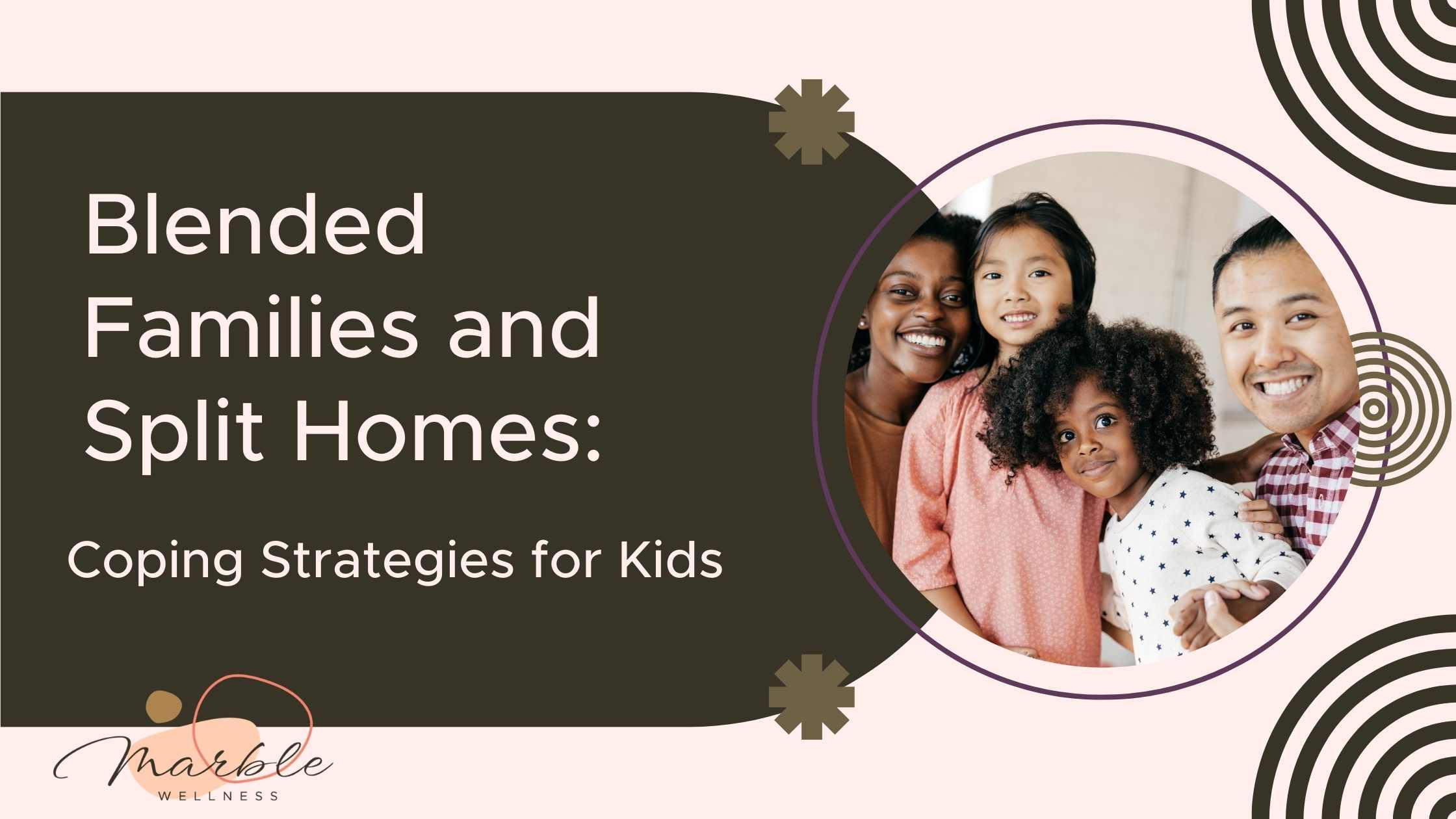
Blended families and split homes can be incredibly loving, but they can also feel confusing and overwhelming for kids—especially when they’re moving between two houses. With some intentional, steady support, you can help your child feel safe, seen, and connected even as life looks very different from how it used to.
Why blended families feel so big for kids
Even in the most peaceful situations, kids in blended families are juggling a lot.
Common emotions you might see:
- Confusion about new roles, rules, and routines.
- Grief over the “old” family that no longer exists.
- Worry about being loyal to both parents at once.
- Jealousy or insecurity with new step-siblings or a new baby.
- Anxiety moving back and forth between homes with different expectations.
If your child is more irritable, clingy, quiet, or argumentative since the family changed, that doesn’t mean you’re failing. It usually means their nervous system is working really hard to adjust.
Start with emotional safety: “All your feelings get to be here.”
The most powerful coping tool for kids in split homes is feeling emotionally safe with you.
Ways to build that safety:
- Name and normalize their feelings:
“It makes sense you miss Dad when you’re here,” or “Of course it feels weird having step-siblings now.” - Avoid “You shouldn’t feel that way.” Instead, try, “I hear you. This is a lot.”
- Give them outlets: drawing, journaling, music, sports, or talking with a trusted adult or therapist.
Kids don’t need you to fix every feeling. They need to know you can handle their feelings without shutting down, getting defensive, or speaking badly about the other parent.
Communicate clearly (and often) in kid-friendly ways
Blended families come with many moving parts, and kids feel safer when they aren’t guessing what’s going on.
Try these communication strategies:
- Age-appropriate honesty: Offer simple, truthful explanations about schedule changes, new partners, or moves—without oversharing adult details.
- Regular check-ins: Short, predictable one-on-one chats (in the car, at bedtime, on a walk) help kids open up gradually.
- Invitation, not interrogation: “Anything you want to share about this week?” instead of “Did your dad do X again?”
- Use tools: Visual calendars on the fridge or in their room to show “Mom days” and “Dad days.” This is especially helpful for younger kids and anxious kids.
Remember: Kids should never be the messenger between parents. Using them to deliver information or complaints puts them in the middle and increases stress.
Create predictability in an unpredictable season
When everything else feels new, routines can help kids feel anchored.
Ways to bring predictability:
- Keep basic rhythms steady: As much as possible, keep consistent bedtimes, mealtimes, and homework times at your house.
- Use simple rituals: Taco Tuesdays, Saturday pancakes, nightly read-alouds, or Sunday walks can be tiny but powerful.
- Plan for transitions: The first 12–24 hours after a switch between homes tend to be the hardest. Build in buffer time with low-pressure activities, like a movie night or quiet play.
Kids read predictability as “I’m safe here” and “I know what to expect,” which naturally reduces anxiety and acting out.
Handling different rules in two homes
Many parents in St. Louis County and St. Charles County share the same frustration: “They get away with everything at the other house.” Or, “They say our rules are too strict.”
You may not be able to control what happens in the other home, but you can still help your child cope.
Key principles:
- Co-parent the differences when possible: Calm conversations (away from the kids) about bedtimes, screen time, chores, and discipline can create more alignment and stability for your child.
- Stay neutral in front of your child: You can explain, “Every house has its own rules. At our house, this is how we do it,” without criticizing the other parent.
- Make expectations clear at your house: Kids handle differences better when your rules are consistent and explained in advance.
This isn’t about winning or losing between homes. It’s about giving your child a stable emotional and behavioral “home base” wherever they are.
Supporting relationships with stepparents and stepsiblings
It can take a long time for a blended family to actually feel like a family. Many kids feel pressured to love a stepparent or step-sibling right away, which often backfires.
Healthier approaches:
- Go slow on bonding: Let kids warm up at their own pace. Avoid forcing hugs, nicknames, or “Now this is your new brother/sister” language before they’re ready.
- Focus on low-pressure shared time: Board games, baking, short outings, or shared hobbies create connection without forcing big emotions.
- Make room for individual relationships: Try to spend one-on-one time with your own child and allow your partner to slowly build their own connection without pressure.
Remind yourself often: Blending a family is a marathon, not a sprint. It’s normal for it to take months or even years for new bonds to feel comfortable.
Coping strategies kids can actually use
Kids in blended families need both internal coping skills and external support.
You can help them build:
- Language for their inner world: Teach feeling words—sad, worried, mad, left out, jealous, relieved—and model using them yourself.
- Calming tools:
- Deep breathing (“smell the flower, blow out the candle”).
- A small “comfort kit” in their backpack: photos, a note from you, a comforting object.
- Movement breaks—trampoline, swinging, walks, sports.
- Planning tools: Using a shared family calendar, letting them help pack their bag between homes, or having a consistent “transition routine” (favorite snack, cuddle, show) after exchanges.
Even teens, who may act like they don’t care, benefit from these grounding rituals and the message: “I know this is hard. I’m here, and I’m not going anywhere.”
What to avoid (even when you’re hurt or exhausted)
When you’re juggling your own grief, anger, or stress, it’s understandable that some patterns creep in. Still, certain things make coping much harder for kids.
Try to avoid:
- Criticizing the other parent or stepparent in front of your child.
- Asking your child to keep secrets or take sides.
- Using them as a messenger between adults (“Tell your dad he’s late on child support”).
- Expecting instant love or loyalty toward new partners or step-siblings.
When you slip up—and you will—repair it. A simple “I shouldn’t have said that about your dad; that wasn’t fair to you” is incredibly healing for kids.
When therapy can help (for kids, parents, and the whole family)
Sometimes, despite everyone’s best efforts, the emotions and conflicts feel too big to carry alone. Signs your child might benefit from extra support include:
- Big changes in sleep, appetite, or school performance.
- Intense irritability, meltdowns, or withdrawal.
- Strong anxiety around transitions between homes.
- Persistent guilt (“This is all my fault”) or feeling “stuck in the middle.”
In those situations, therapy gives kids a safe place to untangle their feelings and learn coping skills. It can also give parents space to:
- Align on rules and expectations across homes.
- Learn communication tools for high-conflict co-parenting.
- Explore your own grief and stress so you don’t have to “hold it together” alone.
At Marble Wellness in the St. Louis area, we regularly walk with families in Ballwin, Kirkwood, Chesterfield, Clayton, St. Charles, O’Fallon, Wentzville, Union, and Warrenton through the realities of blended families and split homes. Our work often focuses on helping kids feel secure again while also supporting parents who are trying very hard in a very complex situation.
Gentle next steps you can take this week
If you’re parenting in a blended family or split home right now, you are carrying a lot. You do not have to overhaul everything at once. Choose one or two small shifts and start there.
Ideas to try:
- Set aside one predictable weekly one-on-one time with each child, even if it’s 15 minutes.
- Create or update a simple visual schedule showing when your child will be in each home.
- Pick one new calming ritual for transition days—like a special snack in the car, a walk around the block, or 10 minutes of quiet play.
- Practice one validating sentence, such as “I believe you” or “It makes sense you feel that way.”
If you’re in the St. Louis or St. Charles metro area and want support for yourself, your child, or your blended family, you’re welcome to reach out to Marble Wellness to explore whether individual, child, or family therapy might be a helpful next step. You and your child deserve steady, compassionate support as you build a new version of family that can truly work for everyone.
Start Therapy in the St. Louis Area
If you live in the St. Louis metro area and are ready to improve your mental health, our expert St. Louis therapists are here to help. Not only do we have a team of therapists in Ballwin, MO, but we have also recently expanded to serve the Lake St. Louis and Wentzville area! Reach out to our Client Care Coordinator today to discuss your therapy options, both in-person and via online therapy in Missouri.
Contact Us!
Learn About Our Group Offerings

About Our St. Louis Area Therapists
The St. Louis area therapists at Marble Wellness are licensed mental health professionals serving clients in Ballwin, Lake St. Louis, and throughout the greater STL area, with online therapy in Missouri available across the state. Each member of our expert therapist team brings advanced training and extensive experience in areas like anxiety, depression, trauma, grief, life transitions, and relationship concerns.
When you reach out, you are matched with a therapist whose background, specialties, and style align with your goals so you can have both practical tools for right now and deeper insight for long-term change. To learn more about the therapists at Marble Wellness, visit our Meet Our Team page to read individual bios, specialties, and locations, and to take the next step toward the calmer, more fulfilling life you’ve been wanting.
Additional Counseling Services at Marble Wellness in St. Louis, MO
Marble Wellness Counseling services are designed to help set you on a path of living a more fulfilled, calm, and happy life. Our St. Louis area therapists have a variety of training backgrounds and areas of expertise. We have child and play therapists, therapists for teens, EMDR therapists, men’s mental health experts, couples therapists, and more! We specialize in anxiety, depression, grief, chronic illness, trauma & PTSD, life transitions, and maternal overwhelm. Our practice also specifically helps new moms with various postpartum concerns, moms in the thick of parenting, and moms with teens. We can also chat from wherever you are in the state with online therapy in Missouri. No matter where you are in your journey, we are here to help you thrive!