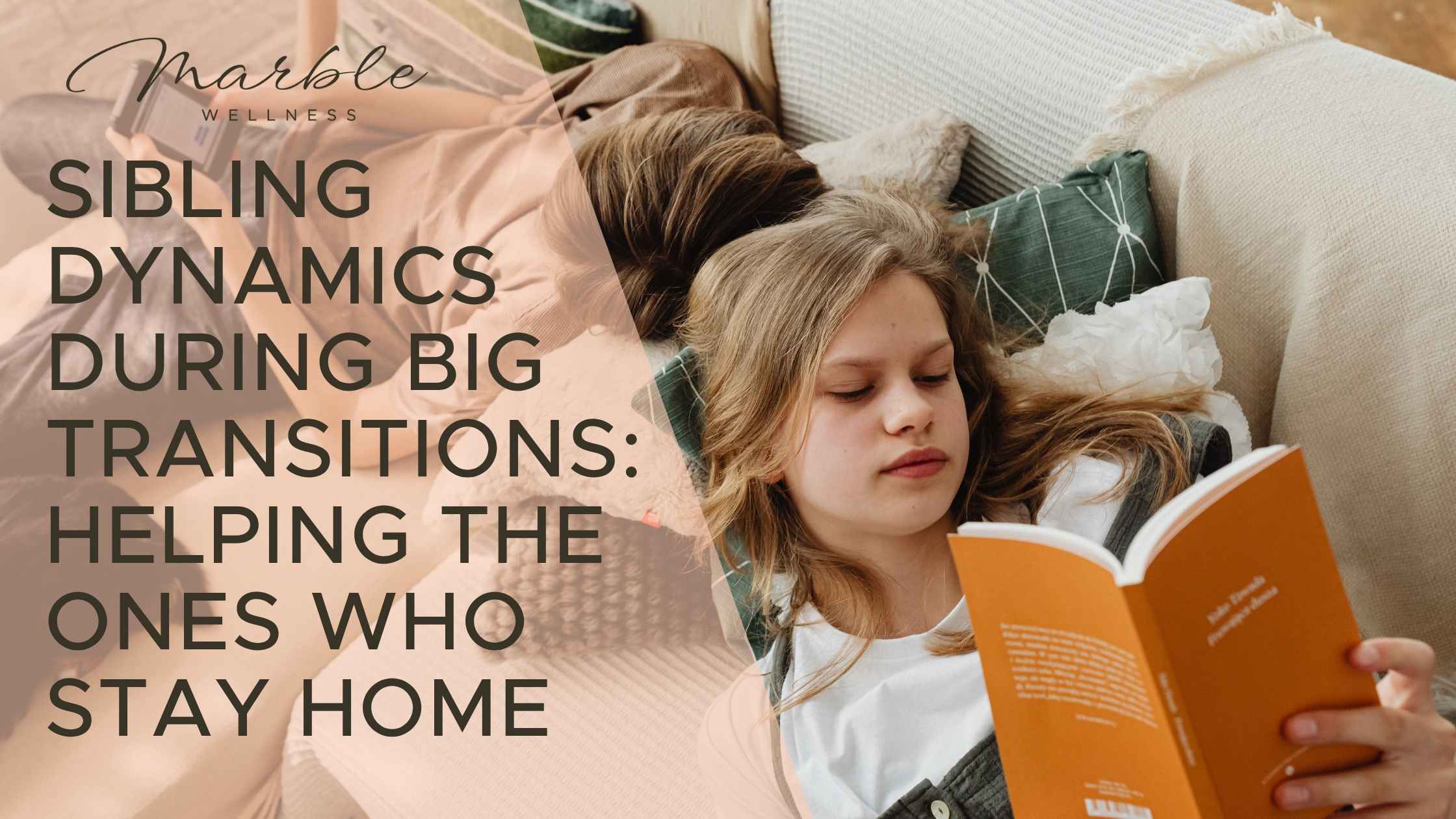
When your oldest graduates and prepares to leave for college, every corner of the house seems to hold emotion. You’re packing boxes, attending celebrations, and adjusting your mind to a new kind of family life. But for your other children, this transition carries a quieter weight.
You might notice your younger kids acting differently as graduation approaches—more clingy, more distant, or simply unsettled. They may not show it directly, but siblings often feel the ripple effects of big family changes. Amid all the focus on the graduate, it’s easy to miss that everyone else is transitioning, too.
At Marble Wellness, we often hear parents say, “I didn’t expect my younger kids to be so emotional about this,” or “I thought they’d be excited their sibling was moving on.” It’s normal for siblings to hold complex feelings. Understanding that emotional range—and creating space for it—can help your family stay connected during this season of change.
Why This College Transition Feels Different for Siblings
When one child leaves home, a subtle family recalibration begins. Every member shifts to fill new roles and routines. The rhythm of mornings, meals, and evenings changes. An only child isn’t the only one who experiences “empty nest” feelings—siblings often do, too.
For younger children, the absence of an older sibling can feel like a hole in the family’s daily soundtrack. The laughter, teasing, and familiar background noise vanish. Even if they didn’t always get along, familiarity offers comfort. When that dynamic disappears, it leaves space that can feel lonely, even while life continues as usual.
Middle and high school-aged siblings experience an added layer. Watching an older sibling’s big milestone stirs excitement and pride, but also comparison and anxiety. They might wonder, “Will I live up to that?” or “What happens when it’s my turn?” These questions are natural but can surface as moodiness, withdrawal, or heightened sensitivity.
The Mix of Emotions They Might Feel
Siblings deal with the departure of a graduate in different ways, depending on age and personality.
Some might express jealousy: seeing parties, gifts, and extra attention can feel unfair. Others might show sadness or loneliness, especially if the graduate was their go-to companion or protector.
Younger kids might feel confusion, unsure whether their sibling is leaving “forever.” Teens might experience pressure or comparison, worrying they can’t live up to expectations or fearing that the family spotlight will now shine uncomfortably on them.
There’s also the invisible feeling of grief—not over something tragic, but over the daily togetherness they’ve always known.
None of these emotions is wrong or selfish. They are signs that your family’s bonds run deep. Acknowledging that truth instead of brushing it aside helps everyone adjust more peacefully.
How Parents Can Support the Siblings Who Stay Home
This transition is an opportunity to build emotional awareness and connection within your family. Here are practical ways to guide siblings through it with empathy and steadiness.
1. Talk openly about the changes.
Bring up the topic before the departure happens. You might say, “Things will feel a little different when your brother’s gone, and that’s normal. What do you think you’ll miss most?” Starting the conversation early gives them permission to process in real time instead of reacting after the fact.
2. Name their feelings without judgment.
If your child acts out or seems sad, try validating rather than correcting. “It sounds like you’re missing her already,” or “I get that this feels weird right now,” communicates safety. Emotional acknowledgment prevents kids from internalizing their reactions as bad or wrong.
3. Involve them in farewell prep.
Let younger siblings help pack or decorate, even if it’s just folding clothes or adding notes to a care package. Participation creates ownership in the goodbye—it reminds them they’re part of the change, not spectators of it.
4. Keep family rituals alive.
Maintaining consistent routines—like Friday pizza night, bedtime stories, or weekend breakfasts—reinforces stability. After a big household shift, those rituals become emotional anchors.
5. Foster a connection between siblings after the move.
Encourage natural communication without making it feel forced. Maybe the graduate records a short video message or sets up a group chat for inside jokes only siblings share. Ongoing connection strengthens their lifelong bond while respecting the new distance.
Understanding Birth Order Reactions
Yes, we’re not typically the “woo” types around here, but stick with us. Birth order can influence how siblings experience this transition.
- For younger siblings, the absence of an older brother or sister often feels like the loss of a guide or example. Parents can help by emphasizing autonomy and encouraging them to build their own identity instead of trying to “fill the space.”
- For middle children, dynamics shift quickly. They may suddenly become the “oldest at home” and feel pressure to step up or a sense of confusion about their place. Help them see this as an opportunity for leadership balanced with personal freedom.
- For twins or close-in-age siblings, separation can feel almost like losing half of one’s routine. Staying in touch consistently and planning visits can ease that sense of abrupt distance.
Supporting Yourself as the Parent
You’re not just managing your Senior’s launch—you’re also supporting those still at home. That’s a big emotional labor load. Remember that your younger children will mirror your energy. Staying emotionally steady, even through your own sadness, helps them feel secure.
Still, you deserve the same grace you’re giving them. Take breaks, talk openly with trusted friends, and create small moments for yourself. If you feel overwhelmed or guilt creeps in about “focusing too much on one child,” therapy can help you process those emotions.
Parents often underestimate how emotionally layered this summer can be. At Marble Wellness, we help families explore those complexities so they can move through transitions with a sense of grounded connection rather than scattered overwhelm.
Keeping the Family Story Connected
After the first few weeks post-departure, the household usually begins to find a new rhythm. You may notice siblings slowly adjusting, laughter returning, and routines settling. This is the moment to nurture new identities within the family story.
Highlight the ways your younger children contribute to the household. Celebrate their interests and milestones so life doesn’t feel like it’s standing still without the graduate around. Invite them into small decisions about home routines or family traditions going forward.
These small gestures communicate that every member still matters—and that family identity continues to evolve, not shrink.
A Season of Change for Everyone
When one child moves toward independence, everyone grows a little. The siblings staying home learn resilience, flexibility, and empathy, while parents learn the delicate art of balancing nostalgia with presence.
You can help your younger children view this moment not as a loss, but as an evolution of connection. The sibling who left will still be part of family life, just in new ways—text threads, phone calls, and stories shared over dinner.
If your family finds this transition more difficult than expected, therapy can be a safe space to navigate it together. At Marble Wellness, we support families throughout St. Louis, Ballwin, and Lake St. Louis as they manage these big emotional shifts.
Every time your family changes, it grows. This season may reshape the daily rhythm you’ve known, but underneath it all, the same current runs through—love, connection, and the deep knowing that home isn’t just a place; it’s the people who keep showing up for each other, no matter where life takes them next.
Start Therapy in the St. Louis Area
If you live in the St. Louis metro area and are ready to improve your mental health, our expert St. Louis therapists are here to help. Not only do we have a team of therapists in Ballwin, MO, but we have also recently expanded to serve the Lake St. Louis and Wentzville area! Reach out to our Client Care Coordinator today to discuss your therapy options, both in-person and via online therapy in Missouri.
Contact Us!
Learn About Our Group Offerings

About Our St. Louis Area Therapists
The St. Louis area therapists at Marble Wellness are licensed mental health professionals serving clients in Ballwin, Lake St. Louis, and throughout the greater STL area, with online therapy in Missouri available across the state. Each member of our expert therapist team brings advanced training and extensive experience in areas like anxiety, depression, trauma, grief, life transitions, and relationship concerns.
When you reach out, you are matched with a therapist whose background, specialties, and style align with your goals so you can have both practical tools for right now and deeper insight for long-term change. To learn more about the therapists at Marble Wellness, visit our Meet Our Team page to read individual bios, specialties, and locations, and to take the next step toward the calmer, more fulfilling life you’ve been wanting.
Additional Counseling Services at Marble Wellness in St. Louis, MO
Marble Wellness Counseling services are designed to help set you on a path of living a more fulfilled, calm, and happy life. Our St. Louis area therapists have a variety of training backgrounds and areas of expertise. We have child and play therapists, therapists for teens, EMDR therapists, men’s mental health experts, couples therapists, and more! We specialize in anxiety, depression, grief, chronic illness, trauma & PTSD, life transitions, and maternal overwhelm. Our practice also specifically helps new moms with various postpartum concerns, moms in the thick of parenting, and moms with teens. We can also chat from wherever you are in the state with online therapy in Missouri. No matter where you are in your journey, we are here to help you thrive!